Showing posts with label heliconia. Show all posts

Tuesday, July 13, 2010

Meeting with HSI Board Members in Desa Paku, Malacca , Malaysia

On July 14, 2010 a visit was made by HSI Board members to Desa Paku Gardens in Malacca. This visit was made in conjunction with Floria 2010 in Putrajaya.The visit was arranged by Mr. Victor Lee of Singapore.From Malacca they will travel to Singapore where Heliconia Conference with be held started on July 15, and later they will travel to Serawak , East of Malaysia for post conference tour.
A short talk was given by Mr. Mushlim Musa , a heliconia pioneer in the country. He was once a board member of HSI then. Then a talk was given by me on research of heliconia in Malaysia.  I was introduced to the board members including Dr. Kolterman, Dr.Bryan Brumer (Registrar), Carla (Treasurer) and other members from various countries from India, Australia and Ivory Coast. A suggestion made whether to set up repository center in Malaysia, as it was told only seven such centers in the world. We are looking a proposal to set-up one, however 'local member drive' has to be made.
The gathering was very nice , peaceful and  friendly. We were served with local Malaysian sweet cakes or kueh like kueh koci, lepat, kueh ketayap or kueh  gulong etc. and later in the afternoon we we served with local Malaysian menus including sambal tahi minyak with petai, asam pedas with brinjal, chicken, Malaysian salads like ulam-ulam etc.Very very delicious, spicy  and mouth-watering!.
A field visit around the garden as to show visitors some of the exotic heliconis like H. salamonsis ; H. vellerigera (She Kong), H.lapispatha, Costus and a new cultivar H. pakurensis (?). There was also  Phenakospermum guyannnese (the tallest stritlizia in the world).The visitors were also shown Tongkat Ali (E. longofolia) plant an aphrodisiac plant for men which has bitter leaves as well kacip fatimah for women.
Some pictures of the visit as below.

Friday, May 22, 2009

Heliconia lingulata


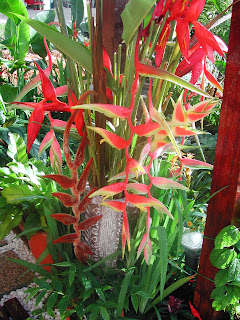
Heliconia lingulata is one the erect flower type. It has very good features namely bright colours, varied bracts, and very distinguish.Potentially used as landscape heliconias and even could become potted plants if its growth be reduced.

Monday, May 18, 2009

Performances of selected heliconias grown under shaded and non-shaded conditions.

Abstract
A study was conducted on five heliconia varieties namely; H.chartacea (Tempress), H. rauliana, H. rostata; H. mariae and H.chartacea (Sexy Pink) grown under in shade and open field (full sunlight). The aim of the experiment was to investigate vegetative and reproductive performances under both conditions. Plants were planted in 50% shade level and non-shade conditions arranged randomly in three replicates.
Results showed the five varieties responded significantly to shade and non-shade treatments. Plants planted under 50% shade were 13.1% higher than that of planted in the open-field. Whilst stem number, flower number and flower percentage were lower by 26.8 %, 67.0.0% and 31.0% when compared to 50% shade and open field treatment, respectively. In terms vegetative growth such as plant height, H.chartacea (Tempress) and H.chartacea (Sexy scarlet) were the highest at 180.9 cm and 86.3 cm, respectively. The most vigorous variety which had highest stem number and flower number is H.rauliana at 116.2 and 26.2, respectively. Both H.rauliana and H.rostata had the highest percentage of flower. A linear relationship between stem number and flower number ( y=25.55+3.1x) (r2=0.84) was observed.
It could be concluded that under shading plant height increase however stem number, flower number and flower percentage reduced. There is strong relationship between stem number and flower number but not plant height and stem number. It demonstrates heliconias are basically sun loving plants, planting these varieties in the open places would result in good flower performances. It was also found that stem number is very important criterion to provide more number of flowers irrespective of vareities.


POTENTIAL HELICONIAS FOR LANDSCAPING


Heliconias are remarkable tropical plants with great stems, leaves and beautiful flowers. They are native to Central America, the Carribean, South America and some islands of the Pacific. There are 500 species and varieties or cultivars worldwide however, 150 species can be found in South East Asia and the Polynesians.

The presence of heliconias in landscaping area makes the scenery more colourful, scenic and enchanting. The unique erect or pendulous distichous to spiral inflorescences adds up more flower diversity and distribution in the vicinity. It lends the landscape, an air of peace and tranquility whatever flower fashion it may have and possesses a fascination that makes magnetic attraction for everyone.

Among the twenty varieties screened, cultural practices pertaining to heliconia growing such as fertilization, shade level requirements, pest and diseases incidence, five promising varieties had potentials based on their planting requirements.
The above pic is my poster .

Sunday, October 5, 2008

Heliconias Are Easy To Grow

If you are flower lovers then heliconia is a good choice. Compare to other flowers like roses, chrysanthemum, orchids, lilies and whats not, then heliconia is very very much easy to grow. There are ample site in the in the internet that you can browse through to get some info.
In Malaysia the earliest species that were grown was H. rostata followed by H.psittacorrum. Later, many entries have been made.
Malaysia is intended to be Garden Nation by 2010, meaning that all the country will be landscaped with beautiful flowers and trees. Here are some Heliconias species introduced.

Here are some excerpts